
March Meditation Month
Join us from around the world for 31 days of free online meditations streamed daily
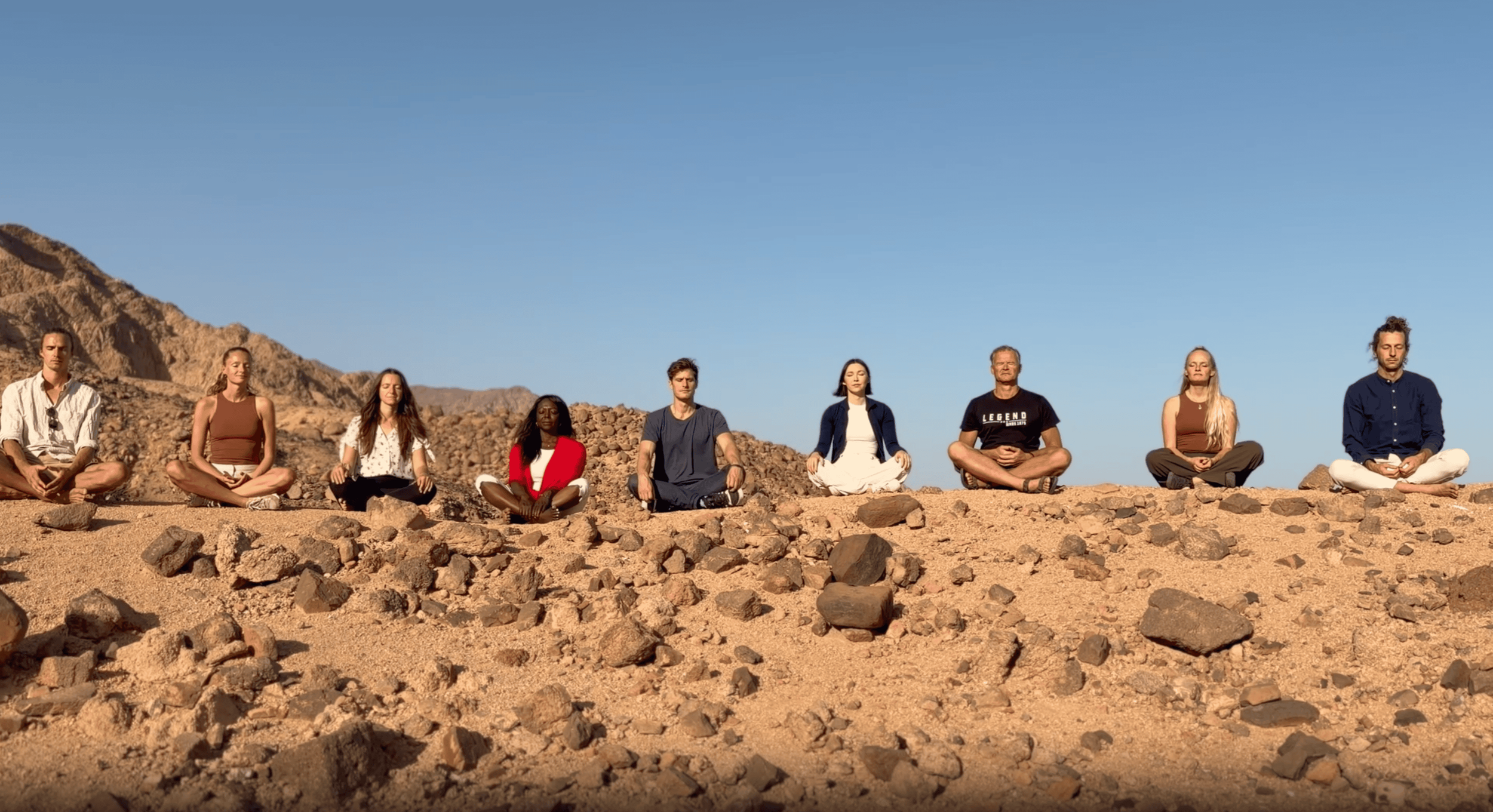
March Meditation Month (MMM) is a free 31-day global online meditation event—a collective return to stillness that ripples a powerful wave of unity through the human collective, touching lives far beyond our own.
MMM returns in March 2026 for its third edition, with a daily meditation streamed every day at 4pm UTC.
Start your day knowing you are part of something larger—a worldwide field of presence where each person shows up with sincerity and openness, committed to deepening awareness, inner freedom, and truth.
We will quiet the mind, return to stillness, and be with what remains. Some call it Freedom. Some call it Awareness. Some call it God. It all points towards the same ever-still, changeless presence that’s at the core of every interaction, thought, ambition, and dream. And it is your true nature.
During MMM, you will be supported daily by a reliable source of love and wisdom, gently guiding your practice toward this stillness.
How to Join
Use this form to submit your name and email. We will email you a Zoom link with access to all daily live MMM guided meditations throughout the month.
You can choose to receive daily email reminders, sent one hour before each session, by checking the box before submitting the form.
We recommend joining about 10 minutes early, so you have time to settle in before the meditation begins.
Meditation: Avoiding the Pitfalls
An Article from Cory, Bentinho's teammate
“Meditation is challenging because Self-realization is the one skill your ego doesn’t want you to develop.”
-
Meditation is challenging.
It shouldn’t be—it’s physically easy. There’s no material obstacle that can prevent you from meditation. No matter how weak, tired, busy, ill, or depraved you are, as long as you are awake, you can meditate.
So why is it hard?
Meditation is challenging because Self-realization is the one skill your ego doesn’t want you to develop. Meditation threatens your mind’s status quo. Therefore, the part of you animated by survival and comfort will do anything in its power to thwart your meditative success.
Beginners get bored, confused, and distract themselves. Advanced meditators hit plateaus, make excuses, and get stuck in “special” states.
I’m Cory. I work with Bentinho Massaro, creator of the hugely popular online course Meditation Mastery and founder of Massaro University.
When I first met Bentinho, I was brand new to meditation—I thought it was tedious. But within months of studying Bentinho’s teachings, I had a meditation breakthrough, and then another, and then another.
At one point I remember laughing and crying simultaneously, saying to myself: “THIS is what I’ve been looking for! Bless my heart for wasting so much time and bandwidth before!”
Now, after years of meditating and seeing fellow students drag their feet, hit ceilings, and get stuck in common pitfalls, I have a better sense of the patterns that wreak havoc on people’s practices.
The more aware you are that your own personality is actively working to sabotage your meditation practice, the more you can preempt its next move and use every hiccup as a launchpad to take your realization further.
I polled our team to discover the 3 Greatest Meditation Pitfalls, and I have compiled the solutions to those pitfalls below.
Use this article as a resource to help you break the ego’s subversion and double down on the soul-affirming work of seeking your essential, timeless Self.
1. Unwillingness to Focus
This pitfall is the most common and universal for beginners and advanced meditators alike.
I use the word “unwillingness” and not “inability” here intentionally. Your mind might have the habit of repeating the story that “I can’t focus! I’m not good at concentrating.” But this is a clever tactic our minds use to prevent us from taking responsibility and seeing the truth, which is: If I am not focusing, it is because I am not choosing to focus.
To confirm this, ask yourself: If the stakes were high enough, could I focus?
Of course you could. And if you can in some circumstances, that means you can. Period. Taking responsibility for your attention—the one thing you can control—will empower you to own your focus; and not to outsource it or make excuses for it.The unwillingness to maintain a mostly steady stream of concentration derails meditation for everyone at certain phases in their journey. Not only does it interfere with your ability to meditate, it also disrupts your relationships, work, recreation, hobbies, and almost everything else you do at one point or another.
Here is how to overcome the pitfall of being unwilling to focus:
Step 1:
The first step is to recognize your unwillingness to focus and decide to use one of the following tools. Without this first step, you will remain unfocused and continue feeling at the mercy of your own attention span. The moment you decide, “I am currently unwilling to focus, but now I am going to do what it takes to focus,” options for concentration will open up to you.
Step 2:
Try one of the following tools. You’ll notice that one is more practical / physical, and the other is more vibrational / intuitive. Experiment with both.
Watch and listen. When I find myself unwilling to focus during meditation, I often use this hack to bridge the gap from distractibility into a meditative state. Instead of persisting or half-assing the practice, I bring up a guided meditation by one of my favorite teachers on YouTube, I set it up in front of me, I put in my headphones, and I watch and listen (as opposed to just listening) until my wandering focus subsides and streamlines. Watching AND listening helps to orient all your senses in a meditative direction and helps to prevent thought tangents. After about half an hour, you can likely continue meditating without guidance.
Meta Concentration. Meta Concentration is a powerful practice to rapidly empower and strengthen your will. It is one of those secret keys not often taught that opens gateways to meditation and Self-realization faster than regular concentration can do by itself. This form of concentration is when you concentrate on concentration itself. This is something to practice as often as you can—as it directly strengthens the “concentration muscle.” Start by concentrating on the sense/image/experience of yourself concentrating. Abide there. Amp it up. What does it feel like to be totally concentrated on concentration itself?
2. Identifying with Special States
At the beginning of your meditation journey, you are likely to be identified with your body, your mind, your history, your memories, your relationships, your personality, and your life as you know it. This is common. If you meditate effectively, you will soon begin to discover that you are not any of those things. But ego identification doesn’t end there.
The ego has increasingly subtle layers and can be deceptive the further you go. Remember, it does not want to let go, so the more you awaken, the more the ego works to create new ways to keep your attention and identification.
As you start making breakthroughs into more clarity and emptiness, you might feel excited or grateful to have accessed a state of more nuance, bliss, or peace. This is a great indicator of progress, but many will be tempted to “claim” or identify with this new special state. For some people this act of claiming might only happen for a moment until they realize they have grasped onto the new state. But for others without a humble awareness of this pitfall, it can last a lifetime.
Here is how to overcome the pitfall of identifying with special states:
Notice the claim. Again, like the previous pitfall, the first step is to notice that you have identified with a subtle or special state. Feel free to celebrate internally for a moment to encourage yourself along, but don’t indulge the temptation to “own” or identify with this new state. Whether you just claimed an experience momentarily, or you have been identified with a realization for the last 20 years, admitting it and recommitting to the practice is the solution.
Active Inquiry. In active, penetrative self-inquiry meditation, this can be instant. You might ask: “Who is aware of this?” and then directly experience the knower for a moment, only to automatically “claim” or identify with that direct experience a second later. If you are sensitive and focused enough, you will notice that the moment you claim the knower, you will lose the direct experience of it. Drop it instantly and refocus on the question: “Who is aware of this?” and keep your answer experiential, as opposed to giving it a label.
Give the experience zero meaning. Whether your meditation is empty and blissful or chaotic and confusing, learn to simply not interpret the content of your meditation, and keep your attention on the changeless container of all experiences: Awareness itself.
Develop a proper preparatory attitude. Bentinho often stresses the importance of preparing for meditation, and he teaches about the ideal preparatory attitude that will set your meditations up for success over the long haul. There are several guiding mantras that develop an ideal preparatory attitude for meditation. Two examples of such powerful preparatory mantras are: 1) “I don’t want anything from anything or anyone—at least for the duration of this meditation" and 2) “It does not matter what I’m experiencing.”
3. Lack of Confidence
A lack of confidence is a major limiter to many people’s meditations. They judge themselves for doing it wrong, tell themselves they don’t have what it takes, worry that it will just take too much time, or the very common: “Enlightenment isn’t for me.”
Like the first pitfall, this one has implications for all areas of your life. If you lack confidence in your meditation, you probably also lack confidence elsewhere. This is a broader topic, and fortunately it’s solvable.
Here is how to overcome a lack of confidence:
To become confident (in anything, but let’s stay within the context of meditation for now), you need to understand the Emotional Guidance System.
The Emotional Guidance System is a fancy description for a better way to understand and use your emotions. Most people think their emotions (whether positive or negative) are accurate interpretations of whatever they’re seeing or thinking. If someone feels insecure, they interpret that feeling to mean that something is legitimately wrong with them. If they feel angry, they believe the accompanying thought that whoever upset them is a jerk.
Instead, start to see your emotional experience as a simple barometer that tells you how relevant (true-for-your-path and aligned with your higher self) your thoughts are.
When you understand the Emotional Guidance System, you will know that the better you feel, the more relevant your thoughts and interpretations of any given experience are. And the worse you feel, the more deluded, misguided, or off-track your thoughts and interpretations are for your own highest path.
When you think to yourself: “I’m not cut out for this. I don’t have what it takes. This kind of thing isn’t for me…” you may feel lethargic, worthless, and a little indifferent. In those moments, remember the Emotional Guidance System and ask yourself: “How does this perspective feel?” You’ll notice that it feels bad. Which means the perspective / interpretation you have must not be the best way for you to see this situation. What would be more accurate? What would feel better to think?”
If you persist down this line of reasoning, you might get to better-feeling thoughts like: “I could get better at this. I have learned new things before. There’s lots I had to learn from scratch. I enjoy meditating, and I believe I can have a breakthrough here…”
This feels better—you’re now interested, open, and willing… which is how you know it’s more relevant than your previous line of thinking. The more you trust this process, the more easily you will discredit your own insecurity, and the more confident you will become.
The Emotional Guidance System is easy to discard as “woo-woo,” non-credible, or even risky. When I first learned about it, I was skeptical.
Instead of working to debunk it conceptually, I recommend trying it and applying it sincerely. Put it to the test in your own lived experience. Look for the merit of this teaching, give it an honest effort, and let it speak for itself. The more I committed this “rule” to memory, the faster I grew, the more confident I became, the less time I wasted, and the deeper my meditations went. This has been a key spiritual principle for my own development and learning over the years.
Finally, if you are interested in locking in your meditation practice and taking your Self-realization to a new level, join us for 31 days of consistent (and free) meditations this March:Join us for March Meditation Month. 100% Free.
Join us for March Meditation Month, and uplevel your meditation practice with consistency, togetherness, and powerful curated or guided meditations.
Clearer and clearer, truer and truer, freer and freer.
All my love,
Cory

“Being part of the MMM collective, meditative field in and of itself did so much of the ‘work.’ It helped me to pop some mind bubbles and reach a higher threshold in my self-realization in an accelerative way.”
— Haris, March Meditation Month 2025
“The meditation month came at exactly the right time for me. From the very first session, I felt myself opening up and deeply nourished. As the days passed, I felt more grounded and no longer overwhelmed by daily life. The experience was incredibly uplifting, and the ‘problems’ I thought I had simply fell away.”
— Judith, March Meditation Month 2025
A Daily Rhythm of Stillness & Support
MMM provides daily guided meditations and a supportive environment to deepen your practice.
Daily Guided Meditations
Every day at 4pm UTC throughout the month of March, we’ll gather daily to experience:
Some of the most impactful guided meditations by Bentinho (pre-recorded)
Guided meditations by seasoned MU facilitators, hosted live online
Each meditation focuses on returning to stillness and the direct recognition of your true nature.
Supportive Environment & Daily Routine
You will be meditating alongside many others. Meditating alone consistently can be challenging. Meditating together for 31 consecutive days makes consistency easier.
Here are two sample meditation exercises from Bentinho’s new book, ME: A Book About You:
-
The Two-to-Five Seconds Method (ME BOOK. I, Practice: 1.2)
Take a deep breath, and as you exhale or sigh, relax your references to thoughts about, and imagination of, the “objects of the world.”
In other words: stop mentally elaborating on the imagined world and its endless tray of mental snacks.
In yet other words: stop engaging in the contents of your imagination/mind.
In yet other words: stop actively adding more thoughts to whatever appears.
So, instead of being distracted by whatever appears on your “screen of pure existence, ” choose to rest your attention into this easy, present moment, and for an approximately two-to-five second window of committed attentiveness, recognize the presence of an already-present clear knowing.
Awareness aware of Awareness. Notice that there is an existent, sentient Awareness that is already right here, knowing your present experience of reading this book. Just “do” this: Allow for two-to-five seconds of vivid recognition of the fact that your existence exists, and that this existence, or I AMness, is indeed awake, clear, sentient, wide-open, space-like and aware, right now.
It perfectly and wholly includes whatever you experience, already. Nothing needs to change or be modified for this intrinsic Awareness to be intrinsically aware.
Just notice this fact of Aware Being as clearly and joyfully as you possibly can, for two-to-five seconds at a time.
This is a moment of aligning your consciousness with God’s basic, self-luminous existence—Life’s perfect and all-pervading Unity-Basis. The Great Perfection which is at the basis—and the true nature—of all phenomena.
This is ME aware of ME (as opposed to getting swept away by appearances and forgetting about ME). “Don’t forget about ME!”
Self-recognition is nothing other than noticing your inner knowing of the clear presence of “ME, ” which you already carry with you throughout all your experiences, equally so.
The only difference between the deluded state and the awakened state (as is shown decisively in such two-to-five seconds) is that you deliberately recognize this already-here-presence as purely and vividly as you can.
-
First Activity of Your Day—10 Aware Minutes (ME book I, Practice: 7.1)
Upon waking up from sleep, don’t get out of bed. Except in the case of an emergency or to empty your bladder, if you really need to go, but then go lay back in bed right away. Assume a prone position as soon as you wake up. Just look up at the ceiling or close your eyes, as long as you stay awake if you close your eyes.
If you prefer to sit up, or if you know you’re going to fall asleep if you lay prone, then you can also sit up straight in your bed against the wall or backboard of your bed.
If you have a meditation space or cushion near you, feel free to go straight there instead, as well. But in general, I simply recommend staying prone and motionless in bed as soon as you wake up.
It is important that you do your best to not think too much, if at all, about your personal life, schedule, work, relationships, world, things to do, etc., upon waking up. Hence: Do not check your phone, email, texts, etc.
If you have a partner that you share a bed with, perhaps inform them abou this practice of yours, so they don’t think you’ve gone catatonic or that you’re on a relationship-strike. If you have a partner who vehemently thinks this practice is weird and stupid, perhaps you should consider changing. your environment (partner) to a more intention-nourishing one. This is only half a joke.
Then, for the first ten minutes of your waking state that day, commit to lying flat on your back, looking up at your ceiling motionlessly, with eye open or closed, depending on which option feels more “awake” and “clear to you.
Pretend your body is still asleep, or in stasis, or imagine it is made of rock—as if your body is a beautifully carved Greek marble statue. But, in essence, pretend you can’t move it. Total motionlessness, yet alert. Be a statue + Awareness; be a conscious, sentient statue.
This (pretending to be a motionless block of marble) will also help your mind to stay more motionless; less distracted by appearances, including
Now, as your eyes stare at the ceiling (feel free to blink, breathe, swallow, etc.) all you do is this: Rest in and as Awareness. Notice the natural presence of intrinsic Awareness; maintain the innermost sense of “I” or “I exist.
” Keep noticing that Awareness is present.
Even if your mind feels kind of cloudy from just having woken up, you may begin to notice how intrinsic Awareness is nevertheless clear on your mind being cloudy. A feeling of cloudiness is known clearly. You may even notice intuitively how this Awareness did not existentially go anywhere, even while your mind was heretofore sleeping and unconscious of your personal world—just minutes earlier. There was still this same motionless, deep presence with you during dreams and deep sleep.
For these ten minutes, firmly rest your attention in active recognition of Being Aware. Just keep noticing that your Awareness is already aware and don’t give any meaning to what appears within it. Pretend your mind is still sleeping, and notice that Awareness is aware of your motionless body.
Give yourself permission to enjoy this feeling of just being this naked, empty, open, sky-like space of already-ongoing Awareness, and/or highlight the sense of “I exist” that is naturally present in this awareness of Being Aware. Ignore—let be without indulgence—all thoughts and their temptations to move, think or start “doing.
” Stay with that subtle sense of knowing Awareness instead. When thoughts or sensations are noticed, never mind them. Who cares?
You’ve had millions of thoughts and sensations during your lifespan, and Awareness is still here, still clear and totally unaffected by your life’s story.
Simply be committed to staying disengaged from stories, forms and labels, and yet remain highly alert. Stay in close contact with your innermost ME.
That’s it.
Then after those ten minutes, no matter how successful or liberating you judge these ten minutes to have been, simply get up and start your day.
With some practice, you will begin to notice how this helps you start your day with an increased clarity and sense of “background remembrance.”
With consequent days of practice, this effect will increase and compound, and it will eventually ensure that your entire day is as clear and awake as it can be.
This approach gives you the greatest probability of starting and sustaining your day within an intelligent, peaceful, joyful, and expansive flow state; rested in a basis of supreme motionless stability and deep well-being.
Throughout March, we will upload new meditations here, to this page. If you miss one of the meditations or would like to watch any of them again, you can return here at any time to rewatch.
The Meditations
"Surrender until you ARE Surrender. Love until you ARE Love. Have faith until you ARE Faith. Any quality wholeheartedly practiced leads the practitioner into sublime union with that quality."
— Bentinho Massaro

Massaro University (MU) is an online school and community that offers a new paradigm of education, where learning is not a mere accumulation of knowledge, but a return to the limitless intelligence of your true being.
Since 2024, Massaro University has hosted March Meditation Month each year—inviting thousands of seekers into a 31-day global meditation experience, featuring daily live-streamed meditations and teachings by Bentinho Massaro. It’s a collective return to stillness, amplifying clarity, presence, and unity across the planet.
Bentinho is known for distilling the essence of all major spiritual paths—from enlightenment traditions like Advaita-Vedanta, Dzogchen, and traditional Yoga to the best of modern empowerment—integrating what works and ignoring what does not. The result is perhaps the most efficient and complete spiritual instruction on Earth, without dogmatic fluff or loose ends.
For more information about Bentinho and the full range of offerings from him and his team, click here.
March Meditation Month: Hosted in Massaro University
Frequently Asked Questions
-
This meditation month is for anyone who feels a sincere pull inward. Whether meditation is already familiar to you or something you’re still learning to trust, March Meditation Month is designed to meet you where you are.
-
No prior meditation experience is required. The practices are offered in a way that is accessible to newcomers while still rich and meaningful for those with an established practice. Throughout the month, various meditation practices will be gradually introduced, allowing understanding to deepen naturally alongside experience.
-
The sessions take place daily throughout the month of March at 4pm UTC.
-
We will stream pre-recorded meditations from Bentinho and live guided meditations hosted by one of the facilitators.
-
Yes. You’re welcome to join even if the month has already begun.
-
Throughout March, we will upload a new meditation here at the landing page each day. If you miss one of the meditations or would like to rewatch any of them, you can return here at any time during March to watch it.
-
The practices are contemplative and presence-based, oriented toward direct inner knowing rather than technique-heavy effort. They will mainly include guided meditations and subtle inquiries that invite deeper intimacy with Awareness/God/Source itself.
-
Participation happens within the Massaro University community, where you can connect with other seekers walking a similar path.

“Before you breathe, You Are.
While you breathe, You Are.
After you breathe, You Are.”